Mistakes

I am curious about something.

Part of me wishes you were right here so we could talk about this. But from what I can see, many of you who read these posts, live on the other side of the world.

I strongly believe it doesn’t matter where any one of us lives when it comes to being human. We have such similar tendencies, one of which seems to be the idea that it is possible to make “mistakes”.

What I want to ask you is, what if we gave ourselves permission to accept and believe that there are no mistakes? What if we opened our minds to the idea that everything that happens, including our own actions, fits in a grander order, one we generally fail to see? What if, we extended grace to ourselves?

You might be thinking that I’m trying to give us a way out of the harmful, hurtful actions we’ve taken. I’m not.

Each time we do something that hurts someone, we can take responsibility, apologize and try to make amends.

These aren’t the mistakes I’m talking about.

I’m talking about the ones that weigh us down so heavily we can barely manage to move. The ones we keep hidden or camouflaged or blame others for. The ones that weaken us, hold us, harm us.

What if we shifted our perspective and believed in the grander scale of things, where we could properly fit everything that happens? What if we could see how beauty can come from any action, any “mistake” that is made?

I’m not saying it would be easy. It wouldn’t.

What I am saying is that it would be worth it.

Imagine if mistakes we’ve made disappeared, even if it took a minute, an hour, a day, a week for it to happen. Imagine how light we would feel. Imagine if every time you felt you’d made a mistake, you replaced the feeling with love and told others you were sorry if you hurt them. Wouldn’t all of the pain and suffering of our imagined mistakes vanish?

It seems to me that what we perceive as mistakes are in fact golden opportunities. We can be right with the world. We can feel light and be the light.

Time to Reconsider

I have many teachers in my life, some exist in proximity to me, others are farther away. Each of them reminds me of things I want to learn to release or to be at peace with. They are predominantly things that irritate, annoy or upset me.

I guess by now I ought to be used to this, but I’m not.

If I am not careful, I get sucked into their orbit and react in kind. This does not serve me.

To be at peace, I know I need to release any attachment to my version of what is ‘right’. I wonder to myself, how is this done?

At first glance, I’m tempted to accept and embrace what my culture has taught me, which is that I deserve to feel the way I do, about anything. If I can find someone who shares my feelings or who otherwise supports my right to feel the way I do, I have no incentive to make any changes, despite the amount of conflict and internal suffering I experience.

Feeling justified is an end unto itself and it halts all other thoughts and holds me in place.

The other thing it does is it creates a host of troublesome feelings inside me and ultimately keeps me from any sense of peace or freedom.

It’s too high a price to pay.

My feelings create a crack in the doorway, a place where some light comes in. And when the light hits my feelings, I sense there is the possibility for change.

Perhaps my view of the world is wrong. Perhaps there’s another way to view my situation that would be better for me. Perhaps I don’t have to stay in the rut created by constant reinforcement.

This feels like good news to me. I try to open my eyes and heart further. What change could I make that would allow my life to be more peaceful, contented, even joyful?

The first thing that occurs to me is that I could remind myself that there are numerous ways to live in this world. This translates as, my way may not be the best or only way and others’ views might make more sense.

It takes some inner strength to say this out loud to myself. For whatever reason, it’s challenging for me to think I have it wrong, but what a wonderful opportunity it is for me to entertain this idea.

This whole concept is one of suspended belief and judgement. A sort of time out or pause, so that I can reconsider what I believe.

It’s a mind opening invitation I can give myself.

If I sit back and think about any given situation from a neutral position, maybe I’ll see a bigger picture, one that may offer me a wider view and provide space to see if what I believe still rings true.

It feels like a wise choice to make and I’m going to give it a try.

Facing the Right Direction

I learned an amazing fact recently about sunflowers that has a lot to do with how to live a rich, centered, balanced life.

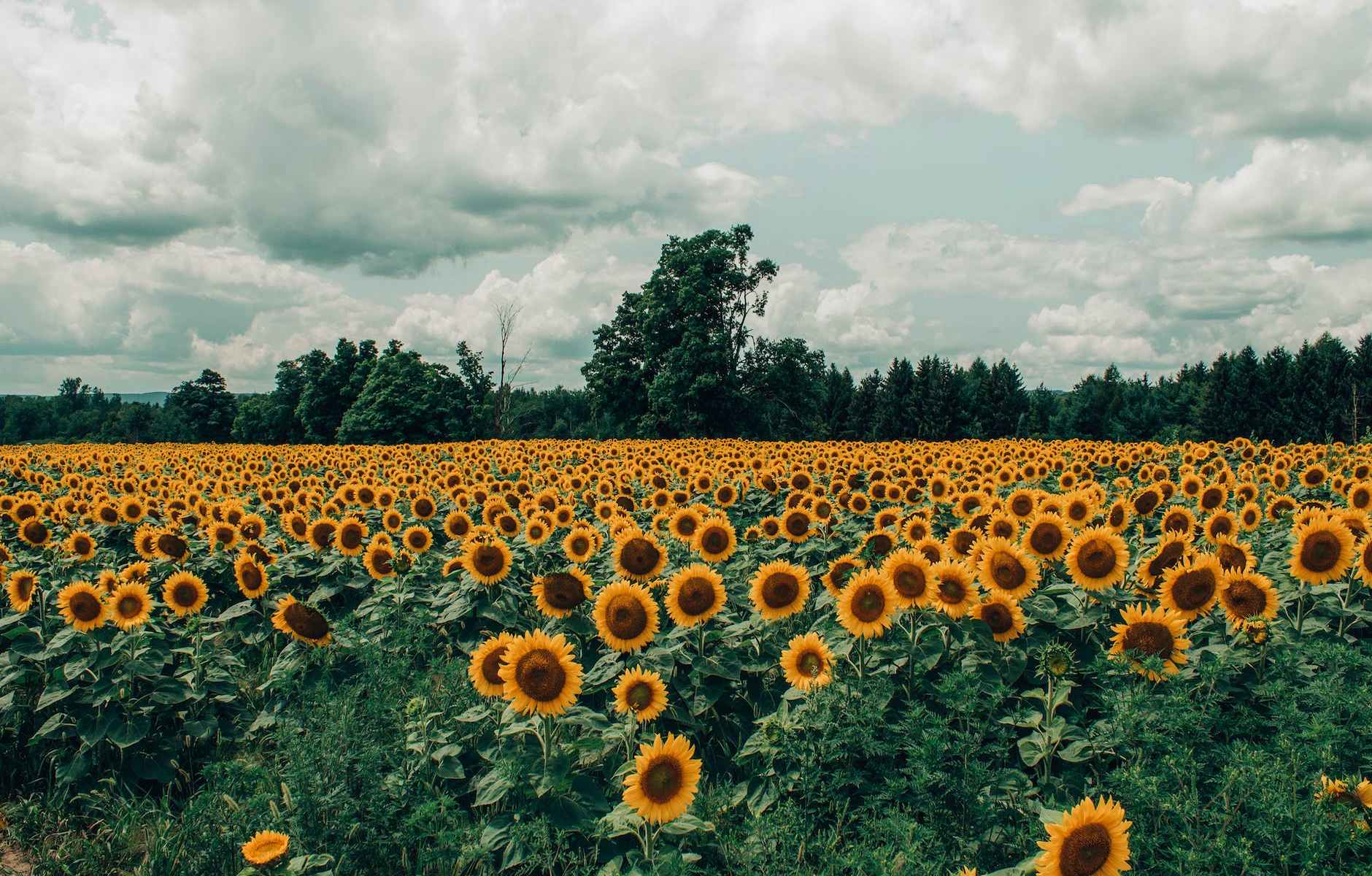
Imagine a field full of sunflowers. Can you see it in your mind? If you need a little help, the internet has lots of photos.

If the sun is out, take a second and see what you notice.

If you said, they’re all facing the same direction, you’re correct. And the direction they’re facing is always toward the sun. Each of their faces is upturned to capture as much sunshine as possible. They’re known as heliotropic because their heads follow the sun as it arcs through the sky.

In the morning sunflowers face east and as the day progresses, they end up facing west. Even more fantastic to me is that once the sun goes down, each sunflower turns and faces east again, waiting for the sun to come up in the morning.

What I find so compelling about this is that sunflowers know instinctively what their energy source is and orient themselves around it. They know the sun will feed them, so they follow it the whole day.

What if we oriented ourselves around what truly feeds and nourishes us?

What kind of life would that provide us?

The question that arises for me is, what is the best source of nourishment? I realize that what I choose will make all of the difference in my life. This idea makes me want to choose very carefully.

If you sat back in this moment, what would you choose?

There are a lot of things to pick from. Money, fame, job advancement, athletic excellence, social influence, strong relationships, popularity.

How do you decide what to choose? Maybe, you don’t want to choose only one. Maybe you want or need more. Maybe you want them all.

Thinking about my answer prompts me to consider whether the list is complete. Are there other things more important than the ones that first came to me?

It only takes a second to reveal my answer. None of these is what I want most. None of these will nourish me over the course of my life and I would be wise to look deeper.

So, I do and discover that what truly is the source of everything valuable in my life is love. If I connect to love in every situation, like the sunflowers connect to the sun, I will always have what I need and want. I will always be fulfilled.

Recently my nine-year-old grandson asked me a fascinating question. He was in the living room and called out to me in the kitchen asking, “What’s the most powerful thing in the world?”

I thought for a moment and said, “love”.

My thirteen-year-old granddaughter overheard both his question and my answer and said to me, “I knew you’d choose that.”

So, there it was, perhaps 30 seconds of elapsed time to reveal some magic and magnificence. He asked an incredibly important question and she reflected to me her awareness, her insight into me, with my answer. I felt ‘seen’. I was touched deeply by this impromptu exchange, and I thought about sunflowers and the way they move with the sun and recognized I am like them because I move to see and feel love.

Love centers me, balances me, and gives me everything I could ever hope for.

If I was ever asked, I would encourage anyone to find their sources of love and follow them throughout the day, then sit waiting for them to appear the next morning, like the sun gazing down on a field of sunflowers.

(OR) Everything Serves You Indirectly

Although unusual, this is the continuation of my previous two posts, all dealing with the interesting and challenging topic of how everything that happens to us serves us, either directly or indirectly.

I realize that it a huge claim and I’m not saying I don’t have my own difficulties comprehending it, but I nonetheless believe it is the truth and I want to share with you why I feel that way.

During recent conversations, Lia, a clear, beautiful feminine voice of grace and love who is always with me and is part of god, began explaining how, even though I may have challenges accepting this idea, it is still the truth.

Lia had previously shared with me an example of how an experience in my life served me directly (see my last post from September 25, 2022). After she pointed out several things to me it became quite clear.

But what baffled me was her statement about how all things serve me ’indirectly’ as well. She told me it would require a shift in my frame of reference and that I would have to release my cultural perceptions, because they limit my ability to see the ‘big’ picture.

She went on to say that I would need to shift from my earthly perspective to a heavenly perspective, at which point I felt I needed a whole new conversation to stretch my understanding.

Lia reminded me of a few of our previous conversations where we touched on this subject. In one of those she told me the following, “Your frame of reference is the KEY. In heaven you know everything there is to know. Every answer to every question. What you may want though is to ‘experience’ life, to create, to feel and think and sense life. In order to do this, you choose to come to earth, and you choose to forget all that you knew, so that you can fully experience life. You let go of knowing how all things are connected and interwoven. You allow yourself to be emptied, so that you can use your free will to decide how to view life. Part of this choice is to accept what your culture teaches you, rather than remembering what you knew in heaven, and you are provided space to make any and all decisions.”

I sat back for a few minutes absorbing her words to me.

Lia continued, “Every experience is filled with meaning and with hints about life (earth and heaven) and completely open to whatever interpretation YOU wish to choose. Each time you choose, you create patterns, pathways that become convenient routes for your thoughts to travel. You allow your cultural training to guide this process and although it saves you from making every decision, it also blinds you to the truth. A part of you already knows the truth, that all things are connected and that all things ‘eventually’ serve you. Some of these are obvious, others are not. They take time to unravel and become clear.”

Wow, this was a lot to take in, and as usual, I needed an example, so I asked Lia for one. I knew I needed to prepare myself, to not automatically reject what she had to tell me, merely because it would challenge me.

I could feel her smiling at me sympathetically, knowing how hard it is for me sometimes. “You can take any situation, and if you look at what happened before it, during it and (most of all) after it, you’ll see there are always connections and outcomes that ‘serve’ you, despite how it may appear. Here is one example I’d like to share. When your job was eliminated abruptly after twelve years and a great deal of success, it shook you to your roots. Immediately separated from your source of income, group of friends and professional colleagues, stripped of some of your sense of self-esteem, and a host of other conflicting thoughts and emotions, a part of you imploded. In no way could you see anything about this that served you. You felt it was not fair or just or right and these reactions blinded you for a period of time from seeing any positive outcomes. That is how your culture teaches you to see the world, in this case, personal rights and wrongs. But that is only a small part of the story.”

Lia went on to share, “You ended up still employed, but at a different location, one that you chose to leave after six months so that you could retire, and as you’ve claimed on numerous occasions, begin your best career- helping take care of your three-year-old granddaughter, Kirsten. This change also provided you the flexibility to write, travel, spend time with family and friends, exercise and many other pleasurable pursuits, all things you would not have been able to do. And it gave you an opportunity to forgive those involved in your ‘firing’ for their actions and insensitivity. And there are so many other connections that came months and years later, ones you are yet to see.”

I felt the absolute truth of her words and recognized that stepping away and gaining some distance allowed me to shift my frame of reference. Part of me could see this whole situation from heavenly eyes and it made all the difference.

Not Falling

When is the last time you fell? Was it more like a stumble and you caught yourself or did you go down spread-eagle and land flat out?

I’ve fallen several times over the years. The most recent time was down the stairs. Well, I should say, down the last stair. It easily could have been avoided. You see, I was carrying something in my arms and couldn’t see the bottom step. I thought I was at the landing, but no, I still had one more step to go. I lost my balance, dropped what I was carrying and couldn’t recover quickly enough to catch the railing. So…down I went. Of course, I fell on top of what I’d been carrying, to add insult to my injuries.

My fall also created a commotion because my family was concerned and came to discover me at the bottom of the stairs, splayed out and more than a little upset.

Worse still, there were many suggestions about how my fall could have been averted. Yes, I knew that already.

Later when I was calm and reliving my adventure, I realized that had I not been carrying anything or had I arranged what I was carrying so that I could see forward and downward, I would not have fallen. As we used to say when I was a kid, DUH!

So why had I carried this armful of stuff and risked a potential fall?

The best I could come up with was, ‘I didn’t even think about it, I just did it. I picked up the stuff and started down the stairs, assuming all would be well.’

Here’s the thing. Had I arrived safely I would not have had to consider my actions, but because I’d fallen, I needed to see if there was a teaching in my experience.

I strongly believe there is a teaching in every single action in our lives. We are so often blissfully unaware of this, but if we took a moment, we might see there could be truth in it.

Case in point.

I sat back and considered, could it be that the same thing happens to me emotionally? Am I carrying too much with me, making it hard to see where I’m going?

If I am excessively thinking about or stressing over something in my life and allowing it to overwhelm me emotionally, is it possible that it results in my falling?

My answer is an unequivocable ‘yes’.

Is it possible we all do this?

I can certainly see how I can lose my balance and become unsteady when I am worried, angry, overtired, jealous, distracted or any other emotional state.

Some of these are very heavy loads.

Might it not be a wonderful idea to release some or most of what I carry with me, especially those things that block my view? To let go of or set down objects or thoughts or habits which take up so much space?

The world offers us an overabundance of concerns. How many can we carry without losing our balance and falling?

It’s a difficult question to answer.

I also know it’s an important one for me. Perhaps it is for you as well.

I think I would be wise to consider releasing anything that feels too heavy, knowing it could cause me to fall. Here’s just one example.

There are those in my world who believe I should stay informed. I should read the paper, follow a news feed on my phone or watch the evening news, so that I stay abreast of world events. They don’t seem to understand the cost of this to me. I feel deeply for what others are going through and it weighs on me, heavily. It overwhelms me and pushes me out of balance emotionally and spiritually. And the truth is, there is little, if anything I can do to remedy the world’s situations.

I must choose what to carry with me and what to set aside. If I want to live a beautiful life, I benefit from paying attention to what I am carrying and whether it allows me to stay balanced.

What Is Your Stride

What is the distance between your feet as you walk? Do you take generously long strides or tentative short ones?

What do you think it says about you?

What messages are you sending to yourself?

It strikes me that there is something quite valuable to learn from spending some time observing this simple physical phenomenon.

I find that I take very long strides. I can gobble up distances quickly, especially if my pace is intentionally fast. The other day I wondered why this was. It seems to be my default. But why? And what, if anything, does it mean to me?

I had to sit with these questions.

As you probably already know, sitting with questions can be somewhat uncomfortable. I find I want to know the answers and am not always patient enough to wait. I’m inclined to want to move on to something I can solve.

Well, there’s a pretty big clue for me!

Perhaps one of the reasons I take long strides is because I am impatient. That feels very familiar to me. I think I’ve told myself this before. And this answer seems to link automatically to another insight. It’s the one about ‘running out of time’.

There is an internal time clock running in the background somewhere inside my head. It prompts me to move and suggests I need to move NOW, or risk running out of time to get done what I say I want.

And the clock is connected to a list, identifying all the tasks and accomplishments I seek to complete. Tick tock, time to move and take some more long strides.

It’s interesting to me, that when I take long strides, I find I often lose my balance. Could it get any more metaphorically obvious?

The sheer act of walking too quickly affects my balance.

Hmmm.

When I’m conscious of this, I try to slow down and shorten my stride and give myself an opportunity to consider the path I’m taking. Would it enhance my life to be more careful and more patient?

I wonder too, where am I going in such a hurry anyway?

I’m not sure exactly. And this observation feels important too.

I encourage myself to stop and sit for a while and consider. Where am I going and how do I want to get there? And how do I want to feel once I arrive? Each of these questions seems worthy of answering.

So, here’s a question for you.

What is the length of your stride?

Is it slow and thoughtful? Is it just the right amount of slow, or is it so tentative that you risk never arriving anywhere?

Does it vary? Does it change whether you’re going uphill (facing hardships or challenges) or downhill (when everything seems easy, and nothing is out of place)?

I wonder whether, like me, you’ve rarely thought about this. I wonder too, whether now that a seed has been planted, what will happen next for you?

For me, I believe it’s time for some changes.

I’m going to try to shorten my gait and stay in balance more often. I’m going to give myself a break by releasing the inner need to beat the clock ticking away inside my head. I plan on hitting the pause button, so that I can find a new sense of balance, without the misplaced belief that I will run out of time. And I’m going to pay attention to the length of my stride and listen to see if it wants to share a message with me.